Geart Tigchelaar wrote a poem to welcome Leeuwarden as a City of Literature



Frysk dichterskollektyf
Last October 24th there was a sociable gathering in café De Basuin in Leeuwarden. As the Danish poet Carsten René Nielsen was staying in Groningen for six weeks to write new material and to translate work by Nyk de Vries, amongst others, RIXT invited him for a performance. Nielsen is a prose poet pur sang, so the evening was centred around that genre. Because of that, our own prose poet Nyk de Vries was invited as well.
The varying occasional formation Reade Runen – consisting of Elmar Kuiper, Cornelis van der Wal, Syds Wiersma and Geart Tigchelaar – which has a connection with Denmark as they were there last April and are busy gathering and translating a collection of Frisian-Danish poetry, performed as well. As said, the composition of the formation varies and Hein Jaap Hilarides replaced Tigchelaar for the evening, as Tigchelaar was hosting the evening.
Tigchelaar started the evening by asking the audience if they were familiar with the term prose poem. Only a couple raised their hands shyly. So, Tigchelaar hoped that the rest of the audience would be familiar with the genre as well by the end of the evening.

Hilarides was the first to perform with verses in Biltsk and even a few in English to allay Nielsen. However, it has to be said that Nielsen is learning Dutch and understands a fair amount of the language already.

De Vries was able to showcase his prose poetry, utilising music and images alternately in his performance. Thus, his set had a more multimedia approach. His performance was superb and it added some variety to the evening as well.

Syds Wiersma travelled through Ireland during the summer, so he poured all his experiences and meetings over there into the mould of prose poetry. Full of narrative and with a rich language he took the audience with him on his travels.

Carsten René Nielsen had made a vibrant selection of his poems from his latest collection Enogfyrre tin (Forty-one things) and Tigchelaar read translations of them in both Dutch and Frisian. Some members of the audience were able to understand Danish, so Nielsen was pleasantly surprised when some laughed along during his original language performance.

After the break it was Elmar Kuiper’s turn who was in high spirits and in-between his poems he told some vivid tales about his expeditions as a young boy with his dad, a cattle photographer.

Next up was return performance by De Vries. He took us along with him to an interview he and others from the Blauwe Fedde literary magazine had had with the Frisian author Rink van der Velde, we sat with him atop a crane in LA, and the next moment in the clubhouse in Harkema. Nielsen added that in his view the Frisian word for clubhouse, ‘kluphûs’, only has a good translation in the Danish ‘forsamlingshus’. According to Nielsen, no other language comes close to the full width of the meaning in Frisian.

Following this, Cornelis van der Wal read four translations of prose poems by Rimbaud, Baudelaire and Revérdy. The last poet is less famous than the others, and Van der Wal had to concede that he himself hadn’t heard of him before either. Van der Wal had translated the poems superbly and the somewhat raw verses accorded well with his own distinctive style of performance.
That the French invented prose poetry can be asserted as fact comfortably. Which was a nice bridge for Nielsen to step in after Tigchelaar asked him to explain to the audience what exactly a prose poem is. It all started in France, but today the genre is mostly practiced in the United States and Canada, not so much in Europe (anymore).
Prose poetry is closely linked to so-called flash fiction. A prose poem often uses narrative as well and is a short form of prose, but it is more poetic in language and more concise. Nielsen would categorise some of the poems in the collections of De Vries as short prose, but Nielsen concludes that the best identifying mark of a prose poem as a prose poem is the author’s own identification of it as such. The covers of De Vries’s collections state that they are prose poems, and thus they are prose poems, according to Nielsen, because this provides a framework for the reader.
No one in the room could add to that, so Tigchelaar thanked the poet collective RIXT and Boeken fan Fryslân in particular for the (financial) support and ended the official proceedings. This allowed everyone in the cosy De Basuin to drink one more with the poets.

At the end of October Ljouwert/Leeuwarden, the Frisian capital and European Capital of Culture in 2018, was designated City of Literature by UNESCO. Leeuwarden is the second Dutch city, after Utrecht, that joins the group of worldwide Cities of Literature.
The project of Cities of Literature started in 2004, with Edinburgh being the first City of Literature. Since then the network has grown, in collaboration with the larger UNESCO Creative Cities Network, to include around 30 cities. Other cities in the network are Ljubljana, Prague, and Melbourne, amongst others.
The UNESCO jury had the following to say about the bid book of Leeuwarden: “The bid-book gave a glimpse of great ambitions. Creative and substantively strong.”
With access to the network, it is hoped that the Frisian literary network can be expanded. That Leeuwarden has been named is a reward of the ambitions of both Leeuwarden and Friesland to keep literature and culture high up on the list of priorities for the city.
Talented Frisian writers and artists will be challenged to contribute to literary projects in Leeuwarden. With the Frisian language, being the second official language in the Netherlands, and the multilingual atmosphere in Leeuwarden, the city together with the province of Friesland will mobilise its literary and artistic heritage and potential, and showcase them in innovative ways on the local, regional and international level.
RIXT is very pleased that Leeuwarden has received this title, since our poets pack wants to reach beyond the Frisian borders and intends to invite poets from other regions and countries to stay here for a while and cooperate with Frisian poets.
At the poetry festival Transpoesie in Brussels, in September 2019, Elmar Kuiper was this year’s Frisian poet who was invited to read from his work. During his stay he wrote a prose poem about one of his nightly walks through the city.

All the same
At the end of a literary evening in Brussels, I drank a Kaapse Pracht with a South African, whom I, miraculously, was able to understand. “A Frisian has a cruel tongue” I proclaimed and ducked out, staggered across a broken-up street and heard a load of sharp s’s and the hard g of an Arab shouting at me even at this late hour. I looked nervously around me and hurriedly crossed the intersection. Near the Holiday Inn our eyes met each other. She sat bolt upright, on a piece of bubble wrap, in the doorway of a restaurant and had wavy hair and dirty cheeks. Wrapped up in a drab blanket she looked me up and down. The white of her eyes became a puddle in which I almost drowned. “Help me, sir,” she whispered, soft as a summer rain, and I reached, generously minded, into my pocket and folded my wallet open, yet not even a penny rolled out of it. “These are hard times for poets as well,” I snapped, as if it was nothing, but she didn’t say anything and just shook her head.
© Elmar Kuiper
Translation: Trevor M. Scarse
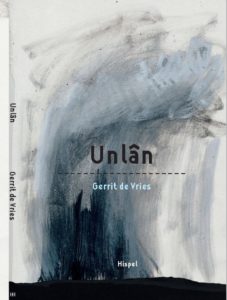
Next Sunday there is a presentation of Unlân, the debut collection of poetry by Gerrit de Vries. ‘Oyster’, the poem below, is a pre-publication. More information about the presentation, you find here
oyster

in the end there is only one question
can you live with yourself or not

like an oyster
naked on a tray
I lie before you
you may
cut the pearls
out of my body
but please
no lemon
no salt

Translation: Trevor M. Scarse
oester

úteinlik is der mar ien fraach
ast mei dysels wol libje kinst

as in oester
neaken op in skaaltsje
lis ik hjir foar dy
meist my
de pearels wol
út de bealch snije
mar asjeblyft
gjin sitroen
gjin sâlt

© Gerrit de Vries
Ûnlân (Hispel, 2019)
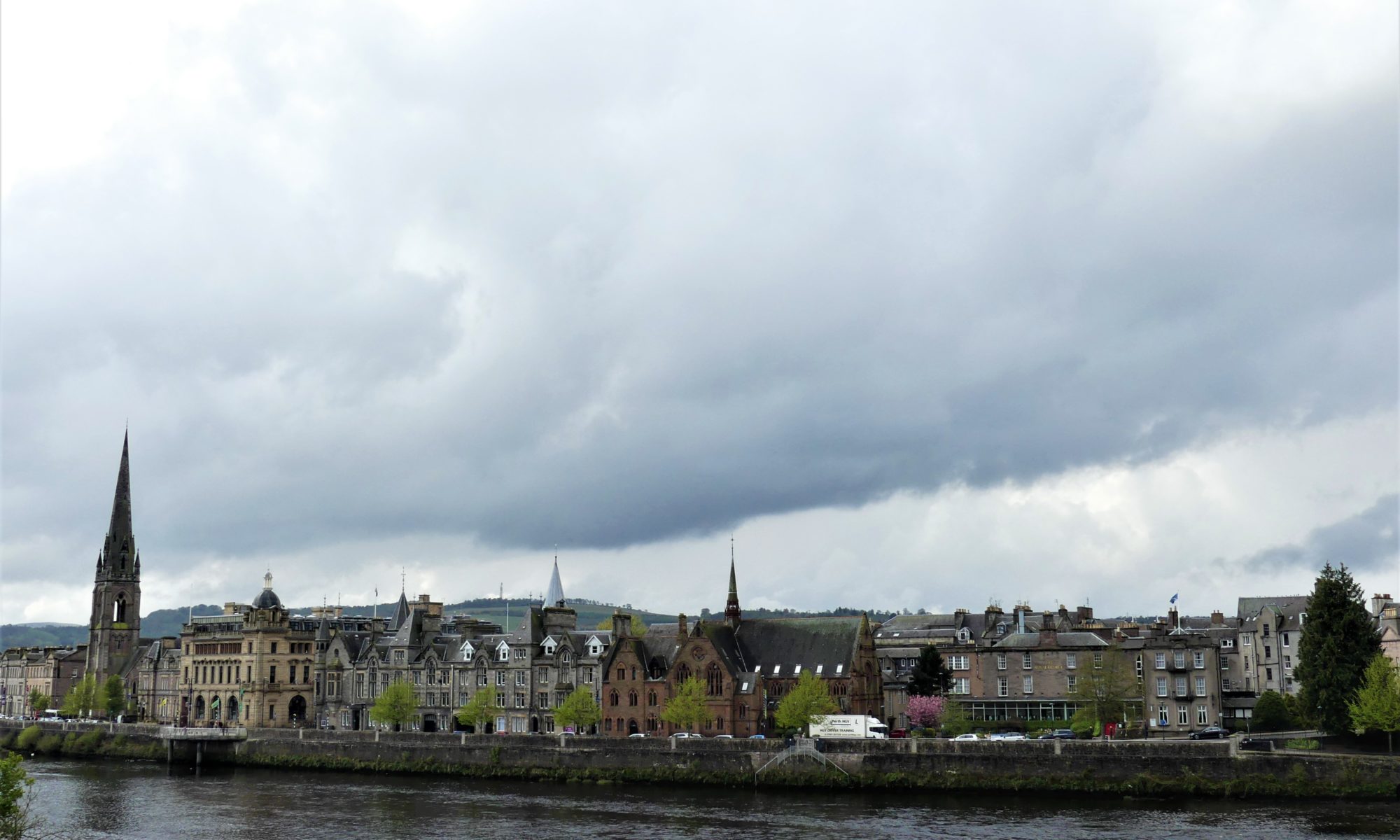
In April 2019, Geart Tigchelaar travelled on his bike to the Soutar Festival of Words in Perth, Scotland. William Soutar, to whom the festival is dedicated, was a poet who published in English and Scottish. He was born in 1898 and died in 1943. From his twenties, Soutar was bedridden because of the Bechterew disease. On the occasion of his bike trip and as a tribute to Soutar’s life and poetry, Tigchelaar wrote a poem. His Scottish colleague Daibhidh Eyre, together with whom Tigchelaar had a performance at the festival, translated the poem into Scottish.
oan the wey tae
the farrest ye’ll gae in fellaship
o yirsel
wi the true boun mates
hings to hink oan an fantasy
aw the days oot the door
oan the soonds trouch the apen windae
wi weel-kent reek
aa afore tae be lived the day
A cycle by him anew
oan a bed in a chamber
fir richt reason o thoan greater
makar
nor A fir whom the warld
lies apen
tire-baunds straik flochty
ower unkent pads
as the dingit pen
ower unscreivit
fell o paper
Translation: Daibhidh Eyre
op wei nei
it fierst giet men yn selskip
fan jinsels
mei de trouwe bûnsmaten
oantinkens en fantasije
alle dagen de doar út
op ‘e lûden troch iepen finster
mei bekende rook
fan alear is de belibbing
op ‘e nij fyts ik oan him foarby
op in bêd yn in keamer
krekt om dy reden grutter
dichter
as ik foar wa’t de wrâld
iepen leit
bannen streekje flugger
oer ûnbekende paden
as de pinne omdoch
oer ûnbeskreaun
fel papier
© Geart Tigchelaar
Poet Geart Tigchelaar has performed at the international poetry festival StAnza in St. Andrews, Scotland, last year. There he met the Scottish poet David Eyre, who was intrigued by the similarities between Frisian and Scots. As a result, he has started with the translation of Tigchelaar’s work. Eyre was asked to talk at the Soutar Festival of Words about the relationship between Scots and Frisian with the poetry of Tigchelaar as an example. The festival organisation invited Tigchelaar to Perth to accompany and strengthen this presentation. A talk about multilingual poetry suited the festival, as William Soutar, whom the festival is named after, wrote in both Scots and English.
On the 28th of April, the room was not crowded, but the people who did attend were greatly interested. That Sunday afternoon it became much more a conversation with the audience than a poetry recital with a talk afterwards. The audience was not only interested in both Scots and Frisian, but also in the distinct similarities between the two languages (see the poem below). Scots is often seen as poorly pronounced English, but Eyre made clear that this is far from true. His aim is to point towards the relationship with Frisian and transfer that Scots is just a variant of the broad Germanic language family. Frisian is regularly described as melodic, also by people who do not know the language. This afternoon in Perth it was noted that both languages share this melodious ring to it.
Eyre plans to continue translating Tigchelaar’s collection of poetry leech hert yn nij jek and hopes to find a publisher in due time.

The poem below is first written in Scots by David Eyre at the StAnza Festival and then translated with the support of Tigchelaar.
Mammietung
For how sad Ah no daur it?
Ah hae a mammietung
an that tung has a freen.
Lee me gang ther, tae her feastmeal
fu wurdies waarm an licht,
an lee me eat ma full.
Ma tung isna sweir
nae band oer ma mou –
her wurdies smak sae guid tae me.
Saut fae ilka sea has worth.
Memmetaal
Wêrom soe ik it net doare?
Ik ha in memmetaal
en dy taal hat in freon.
Lit my gean dêre, oan har feestmiel
fan wurden waarm en licht,
en lit my my fol ite.
Myn tonge is net swier
gjin bân oer myn mûle –
har wurden smeitsje my goed.
Sâlt fan elke see hat wearde.